Monday, January 6, 2025

A Wedding in Haiti, by Julia Alvarez

I knew about Julia Alvarez because I worked at a middle school for about six years, and in the course of that time one of the English classes I worked in read one of her novels-- Before We Were Free. It's about a young woman whose fairly wealthy, upper-class family are high enough in the social strata to get involved in a coup against the dictator at the time. Her father ends up dead, and she, her mother, and her sister end up in Queens, facing a whole new life in New York.

I liked that book, too-- for the kind of thing it is. 

Anyway, when I was wandering through the nonfiction section of the library the other day, I came across A Wedding in Haiti, which starts with the story of how she (Julia Alvarez) and her husband got involved in a coffee farming venture in her home country of the Dominican Republic, and therefore meet Piti, a Haitian-immigrant farmworker whom they sort-of-adopt, and whose wedding they eventually attend.

And, since they are the fanciest people at the wedding, they end up being the godparents of the wedding. (Don't ask me what that means; Julia Alvarez herself seems a little fuzzy on what exactly it means.) And, being godparents of the wedding, they then end up being godparents of the marriage-- which in turn leads them to take a second trip into Haiti so that they can bring Piti's wife back for a visit to her family, whom she deeply misses.

But this second trip is taken right after the devastating 2010 earthquake, and they end up going to Port-au-Prince to get travel documents, and it's funny and sad and moving and all the things. I think I want to own this one. I felt more human after I read it. I feel a little more human even now, just thinking about it.

Monday, November 29, 2021

Rude Cakes, by Rowboat Watkins

 A young cake with ZERO manners spends the first half of the book ignoring its parents, pushing other baked goods out of the way, and generally being in no way shape or form sweet. Then it is taken from its bed by a cyclops who thinks it's a hat. Cyclopses ae extremely polite, and have difficulty even hearing the cake when it says rude things. The cake will have to learn to speak politely, or it might remain a hat forever!

I loved this book for its silliness. I was checking out Amazon reviews, and some reviewers found it too "weird," but one person's weirdness is another person's silliness, sooo... I guess it sort of depends on your point of view. Some of the reviewers thought it was inappropriate for toddlers. I don't know either way on that one. The kids I was reading this to were a small class of second graders, over the summer (I worked summer school), and it was perfect for that particular group of kids. 


Tuesday, October 19, 2021

The African Doctor

 At first glance, this movie seemed to be about whether or not a rural French village will accept a (French-educated) African doctor and his family. And that's almost true. It's definitely a subplot. But the real question is whether a (French-educated) African doctor, who does not want to go home to his native country and become part of the corrupt and exploitative system at play there, can convince his wife to stick it out in a cold, unwelcoming, backwards French village where he has talked himself into a job.

In a movie like Remember the Titans, which is about whether or not Whites can accept Blacks, emphasis is placed on how normal the Black characters are, how they are just like their White counterparts, in order to show how utterly ridiculous the White characters are to even consider rejecting them. Not so in The French Doctor. Dad just wants to integrate, to the point of forbidding the speaking of anything but French at home*; Mom just wants to go home, which ends up in a life-altering phone bill; but when aunties and uncles and cousins from Belgium show up, partying in their very African, very non-French way, all of Dad's carefully constructed "we're just like you" facade begins to break down. 

This is what I love about this movie. It has the confidence to let the relatives be weird. It's a fish out of water story, but with the fish being Black and the non-water, as it were, being White. And the stakes are integrity and marriage, and I don't know of any higher stakes than that.

One more thing that might help you understand this movie a little better upon first viewing than I did: the narrator, the now-grown son, is in real life a stand-up comedian. The African Doctor is based on a book he wrote about his childhood. I think I might have missed a few jokes the first time, because I'm so darn used to integration narratives being deadly serious. Maybe we could use a few more funny ones, to let us see how ridiculous we all are sometimes.

Poster for The African Doctor

*To be clear, they all speak perfectly good French to start with, but like most Africans, they have at least one African language they can call upon as well. Dad isn't trying to improve their French; he's just forbidding Lingala for the sake of forbidding Lingala.

Saturday, March 13, 2021

The Schmutzy Family, by Madelyn Rosenburg

 After I read it to two neeflings, plotted to read it to two more, and put it on my own to-buy list, I decided that it was probably time to review this book.

The Schmutzy family (from a Yiddish word meaning "dirty") has no concern at all about getting their clothing, house, and selves dirty five and a half days a week. Mom says nothing about most of the messes and even helps stop up the sink when it's time to start a frog habitat. On Friday around midmorning, however, she calls a halt to all that and they clean up for Shabbat. Utterly charming, delightful, and most of all AMAZING at helping kids learn that keeping a few rules doesn't have to make you boring or mean. Reading it even helped me be a little more cheerful about my own Saturday-afternoon cleanup efforts.


Monday, March 1, 2021

El Deafo, by Cece Bell


I learned about this book because I went to an author event set up by my public library-- and I got to see and hear Cece Bell speak. She was/is amazing! She ended up losing 90% of her hearing when she was a toddler, and El Deafo describes a fictionalized version of her life from that time until she was in late elementary school. I mean, the characters are rabbits. Clearly it's fictionalized. But I feel like it offers an emotionally safe way for younger persons to consider what it might really be like to be deaf, mostly because the reader gets so caught up in Cece's world that it becomes easy to identify with her. On top of that, she mentioned* how she hopes it will help kids who feel... different... like their lives could turn out OK. I'm not a kid, and I still feel like it left me with this message.

*I'm paraphrasing what I remember from an event several years ago. Please don't be mad at me, Cece Bell, (if you see this) if I got your words wrong! (But do please email me, because I want to get it right.)

Gamayun Tales, by Alexander Utkin

 Graphic novels "based on traditional Russian folklore." Exciting, fast-paced, not too gory or overtly sexual for my extremely tame tastes. Has bad guys, but none that are so bad that they automatically deserve to die just from their category. If you find folk tales satisfying, you will find these satisfying. I only checked out the first three in the series (The King of the Birds, The Water Spirit, and Tyna of the Lake) but plan on getting more as soon as there is room on my library card :). These are also going on my to-buy list.


The Flying Witch

 Jane Yolen, legend of storytelling for extremely good reason, did not disappoint as she added to the already-established genre of Baba Yaga tales. I loved that the little heroine was clever, and I loved that her dad literally saved her with his turnip truck. It's a picture book. It's a quick read. And it's going on my to-buy list.

Monday, May 4, 2020

Joanne B. Freeman's Yale Free Online American Revolution Course

One of my VERY favorite new listening experiences in the past month has been the discovery of Joanne Freeman. I spend a fair amount of time longing to BE Joanne Freeman at this point, while steadfastly reminding myself of the Oscar Wilde quote that one of the speakers used at my college graduation: "Be yourself. Everyone else is already taken," and yes, that includes the estimable Ms. Freeman. Darn it.

Why is she so awesome? I could just tell you that she's funny, smart, enthusiastic and cheerful, and I would not be lying. But instead I'm going to quote my best Joanne Freeman story about herself. Actually, it's the only story I've ever heard her tell about herself, and she does not tell it in the online lecture course-- she told it at another online event. (I have yet to be disappointed with any of these, BTW.) So, when she was fourteen, it was the bicentennial of the United States, and she being the geeky teenager she was, was reading through the biographies of the founding fathers. But when she got to Alexander Hamilton's biography, she found it unsatisfying, so she asked for a recommendation from her public librarian. The public librarian pointed her to the 27-volume set of Alexander Hamilton's collected correspondence, and she proceeded to read it through the way I read scriptures: once you finish one read, you have to go back for another immediately.

You will perhaps see why it was not surprising that she ended up with a PhD in history, teaching at one of the oldest/best institutions in the country. I think that my favorite part of her really is her delight. She always seems to be genuinely happy to be talking to students, or audiences; she loves to answer questions; she chortles when she brings in a great story or especially wonderful primary source document. I'm not quite sure if it's because of a) genetics, b) gratitude that she got to study and now teach something she genuinely loves, c) the fact that her subject area is a time of history when people REALLY thought things might not work out, and then they pretty much did for the next 200 years, or d) upbringing-- but whatever it is, I find her extreme cheer to be one of the most cheering things I have encountered in a long time.

Monday, April 20, 2020

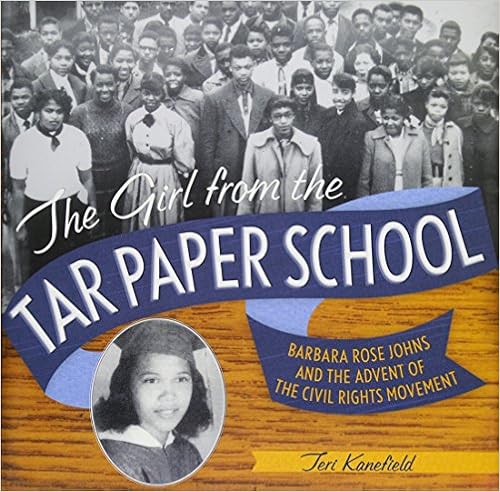
The Girl From The Tar Paper School

Barbara Rose Johns was a Black high school student compelled to attend classes in a truly inadequate physical building: the roof leaked and the rooms were cold in the winter and hot in the summer, and the reason for this is because the walls were, for pity's sake, made of tar paper. (You know, tar paper? The stuff you use on a roof underneath the shingles, or perhaps for a temporary shelter?)

The local school board kept promising that they would build a facility for the Black children that even remotely came close to the brick building which had been serving White children for several years, but nothing ever came of that.

Barbara was a serious student, and this situation bothered her. She was also religious, and so she prayed about what she should do. And that is why, without notifying or in any way involving any adult whatsoever, she organized a walkout of all of the students in her high school. "They can't throw us all in jail," she reasoned.

She wasn't a rabble rouser. She went on, in fact, to become a public librarian. But she had to do something, and she did what it took.

The case that was started on her behalf became part of the class-action lawsuit I grew up knowing as Brown v. Board of Education. She is one of my heroes.

(Also, this book does a fantastic job of telling the story through words and pictures. Highly recommended.)

Thursday, March 26, 2020

Netflix's Lost in Space

So, I baaaarely remember a tiny part of exactly one episode of a rerun of the original series. And I didn't see the movie remake from a few years ago, so when I was excitedly telling N about this series, and she said, "You don't watch Lost in Space for the plot," I said, "Ummmm...."

That said-- and with the caveat that the only thing I know about the other two iterations is what I learned from reading about them on Wikipedia-- this one is worth the watch. Tension-filled, heartwarming-- but also incredibly family-centric, with stupid (or foolhardy) decisions actually playing out the way stupid decisions are likely to. And all this is done without the whole thing feeling like a morality play, which is why people sometimes shy away from that kind of realism.

I'm the sort of bear who will fast-forward when there's too much suspense, so I probably missed about half of the first episode. Afterwards, I was talking to a friend who suggested I just mute the sound next time, so, while I didn't go back, I have seen much more of the rest of Season 1 and the first part of Season 2. Since Season 1 ended on a cliffhanger and they have no incentive not to do that for Season 2, I've been waiting to finish Season 2 until 3 was out.

Hmm. I only remembered one curse word in the whole series, then looked it up on Common Sense Media and found out that there is at least one per episode! Maybe I'm not the most reliable source for this. If you're a parent, watch it before you let the kids watch-- but if you like exciting stories, but feel frustrated by the moral vacuum that most exciting-story-characters seem to live in, this will probably suit you fine.
Lost in Space Poster

Tuesday, March 3, 2020

Klaus

If you're the kind of person who is likely to like this sort of thing, you have probably already seen it-- but Netflix's Klaus was quite lovely indeed. You do need the context at the beginning that it's a Santa Claus origin story, because it takes a minute to get off the ground, but it all pays off in the end. It gets all the points for silly, most of the points for heartwarming, and many of the points for funny. I thought it should have won the Oscar (though I haven't seen the one that won, so...)Joan Cusack, Jason Schwartzman, Rashida Jones, Sergio Pablos, Will Sasso, J.K. Simmons, and Neda Margrethe Labba in Klaus (2019)

Sunday, September 1, 2019

Solubility table

This is a table my husband constructed out of some solubility rules I had to memorize. The format makes it much easier to remember than other formats, so I'm posting it here in case it would be useful to anyone else. As usual on this blog, a creative commons, copy-left license applies. Blogger only allows me to upload the file as an image; if you want/need a spreadsheet or PDF, please let me know in the comments. Because of formatting trouble, the copyright notice is below; it refers to the table. The attribution for the table is A.T. Wilson. Cheers!


Miss Mary Reporting: The True Story of Sportswriter Mary Garber

This is the story of a woman who loved sports, and loved writing about them - and did a very good job at it, at a time when a woman in reporting was expected to be only interested in the society pages. Extraordinarily well written and beautifully illustrated, I recommend this book to anyone.

Wednesday, October 12, 2016

Saints, by Gene Leung Yang

BTW: at the National book Festival a couple of weeks ago, I found out that Gene Leung Lang a) is a Middle School teacher, and b) just got a MacArthur Prize! Cool!

All of Gene Leung Yang's books that I have read so far are complicated, a little confusing, and in the end-- for me-- utterly uplifting. His American Born Chinese got a Printz award, and is also pretty amazing, so go check that out, too. Saints focuses on a fictional heroine living in China at the time of the Boxer Rebellion, who begins seeing visions of Joan of Arc, eventually converts to Christianity, and in the end gets caught between the warring factions in her region. There are no easy heroes in this story, but there are utterly real characters who make me want to be a better Christian myself-- without (I think) being didactic or preachy or manipulative. Read it yourself, and tell me what you think.

Monday, October 3, 2016

Harry Potter and the Cursed Child, by J.K. Rowling

This book was lovely. All the stuff I had felt frustrated about with Harry Potter, especially in the later books-- all addressed.

Not everyone will love it. That's OK. I will say that it's the kind of book I would like to write. As in, not necessarily spectacular, but truly lovely in its own way, well worth owning (in my opinion). Or, at the very least, putting yourself in the hold queue for.

Also, I have a new all-time favorite J.K. Rowling character, but I will wait to tell you until we see each other in person; you can ask then. (If you've read this story, you can probably figure it out.)

Thursday, September 22, 2016

Bad Island, by Doug TenNapel

A story in which we get adventure AND parents get to live AND be involved? Indeed, this rare sort of book does not come along often, and I very much enjoyed the story. (I had been noticing for a while how quickly TenNapel books circulate at our middle school library, and finally decided to give his stuff a try. Glad I did.)

P.S. I also enjoyed Cardboard, by the same author. Sadly, the hero has lost one parent in that story; happily, the remaining parent still gets to be involved with the adventure, while not completely taking over it.

Friday, February 6, 2015

To Kill a Mockingbird by Harper Lee


 I don't know what to say about it, except that it fully deserves the praise that it has collected.  It's brilliant.  Weighty, but up-lifting.  Beautiful.  Honest.  Well worth the read.

Tuesday, December 23, 2014

Being Mortal by Atul Gawande

Atul Gawande has taken a new direction with this book; still exploring what it takes to make our lives - both as a doctor and as a patient - better, this time he looks at the end of our lives. With death both natural and inevitable, what interventions are the most useful? What merely prolongs suffering, and what makes life more worth living- what gives us better, rather than just longer lives?  What interventions actually make things worse?

Aside from the critical, end-of-life stages, what about the later years? At what point is it time to seek assistance, and when do we have to turn over autonomy? Intriguingly, do we ever have to turn over autonomy?  He shares his research about these questions and some answers to them - good answers that are surprising in both what they have in common and what they do not.

Reading this was enlightening for me: Knowing that we all die, and that we all grow old (if we're lucky) - is not the same as thinking about those facts, and knowing how to deal with them.  Thought-provoking and informative, a straightforward read with beautifully clear prose; my favorite kind of non-fiction.

Saturday, December 6, 2014

The Eye of Zoltar, by Jasper Fforde

As the impatiently-anticipated third installment in the wonderful and Strange Chronicles of Kazam series, this book did not disappoint. Fforde's cleverness at plotting-- while not neglecting to include a high ratio of random-- made this one of my favorite reads in a long time.

Saturday, November 29, 2014

The Spark: A Mother's Story of Nurturing, Genius, and Autism, by Kristine Barnett

Kristine Barnett's son, Jacob, was so affected by autism that his pre-K teacher assumed he would never (re-)learn the letters of the alphabet. Now, he has set the world's record for being the youngest paid researcher in Physics.

Ms. Barnett seems to be one of those rare souls who has an intuitive grasp of what will help little children blossom; this book focuses on how she helped this transformation happen. It is neither a straightforward narrative nor a detailed description of her methods. It seems, instead, to be a best-parts version of both.

Her main takeaway message is that we can't give up on any child, even if the school system has declared them to be in essence unteachable. I was raised believing this-- our version is to say, "genius is as common as dirt"-- and it is therefore small wonder that I was so taken with this book.